
At the start of this summer, I only knew two things about science and coding. One, there are eight planets in our solar system. Two, if you start a sentence with the word “print” and put parentheses around a statement in Python, it will display your statement.
When I received my acceptance letter for the Girls Who Code (GWC) Pathways program on April 30 and the Stanford Program for Inspiring the Next Generation of Women in Physics (SPINWIP) on June 18, I knew I was fortunate enough to get the chance to learn about something I’d never tried before. I signed up for these programs since I wanted to step out of my comfort zone and I figured it would be a useful skill to have in my future. Among these, SPINWIP stood out as an exciting chance to explore physics in a hands-on way and connect with people with different interests.
SPINWIP is a 3-week summer program hosted by the Stanford Physics Department and the Kavli Institute for Particle Astrophysics and Cosmology. I attended the meetings on Zoom every weekday from July 7 to July 25 from 9 a.m. to 1 p.m. alongside 79 other participants. Every participant was split into a group with a different counselor. I was placed in a group with Stanford University doctoral student Tara Dacunha as my counselor along with seven other girls. My team and I met with Dacunha and had an hour and a half to complete a worksheet on Google Colab based on what we learned the previous day. At the end of the session, Dacunha reviewed our work and corrected any mistakes.
Throughout the program, my team and I listened to lectures led by Stanford University doctoral students Kaitlyn Karpovich and Azana Queen. The lectures covered Python programming and science-related topics, such as quantum physics and cosmology. After the worksheet, we listened to guest speakers who shared their experiences in their respective science-related fields and answered any additional questions we had.
My favorite part of SPINWIP was the cellular automata project my team worked on. The specific automaton that we had to create was “The Game of Life,” created by Cambridge mathematician John Conway in 1970. This automaton is a virtual simulation where cells die if there are too few or too many cells around them and only survive the next generation if the right number of cells surround them. It took my group three days to figure out how to code it using what we had learned up to that point.
“The most memorable experience I had at SPINWIP was working alongside peers who shared the same perspective and passion as me,” said Washington High School junior Anika Misra, a fellow participant in SPINWIP. “I was really grateful for the chance to meet new people who were also interested in pursuing careers in space science, especially in cosmology. One of my favorite parts was definitely the speaker series. I got to ask professors questions and hear about their personal journeys, which I thought was really cool and interesting.”
The most memorable speaker for me was Massachusetts Institute of Technology STEAM educator Erika Reinfeld. Her presentation was on informal science education and she spoke about majoring in both astronomy and theatre during her undergrad. Reinfeld’s presentation stood out to me in particular and it gave me an insight into what my life would be like if I majored in a science-related and a humanities-related field at the same time.
Shortly after SPINWIP ended, I got started on GWC, an international non-profit organization with the goal of closing the gender gap in tech-related jobs by 2030. The Pathways program is a 6-week self-paced summer program from June 30 to Aug. 8. Pathways offers three different computer science tracks for participants: web development, cybersecurity and data science + AI. Each track had two or more courses that guide participants through video tutorials to create their own project. Participants received a certificate for every course they chose to complete.
“GWC was such a fun learning experience, especially since I had no prior knowledge in coding,” said California High School junior Aashna Singh, a fellow participant in the GWC Pathways program. “I loved making my own website and watching how my code comes to life.”
I started off by doing the cybersecurity track and created two programs: one called “CyHelp” and another called “Breach Bot.” “CyHelp” explained the CIA (Confidentiality, integrity and availability) triad, a security model that organizations use to ensure system reliability and safety. “Breach Bot” explained the 2019 Facebook data breach for users interested in learning more.
The final thing I worked on in GWC was the web development track. I learned HTML and CSS programming to create my own personal website. I had to create a portfolio to showcase my previous work. I also learned JavaScript in order to start making personality quizzes from scratch. This was really fun for me to do in particular after I created a personality quiz based on people on the 2024-2025 DPMHS Student Media staff for Scholastic Journalism Week.
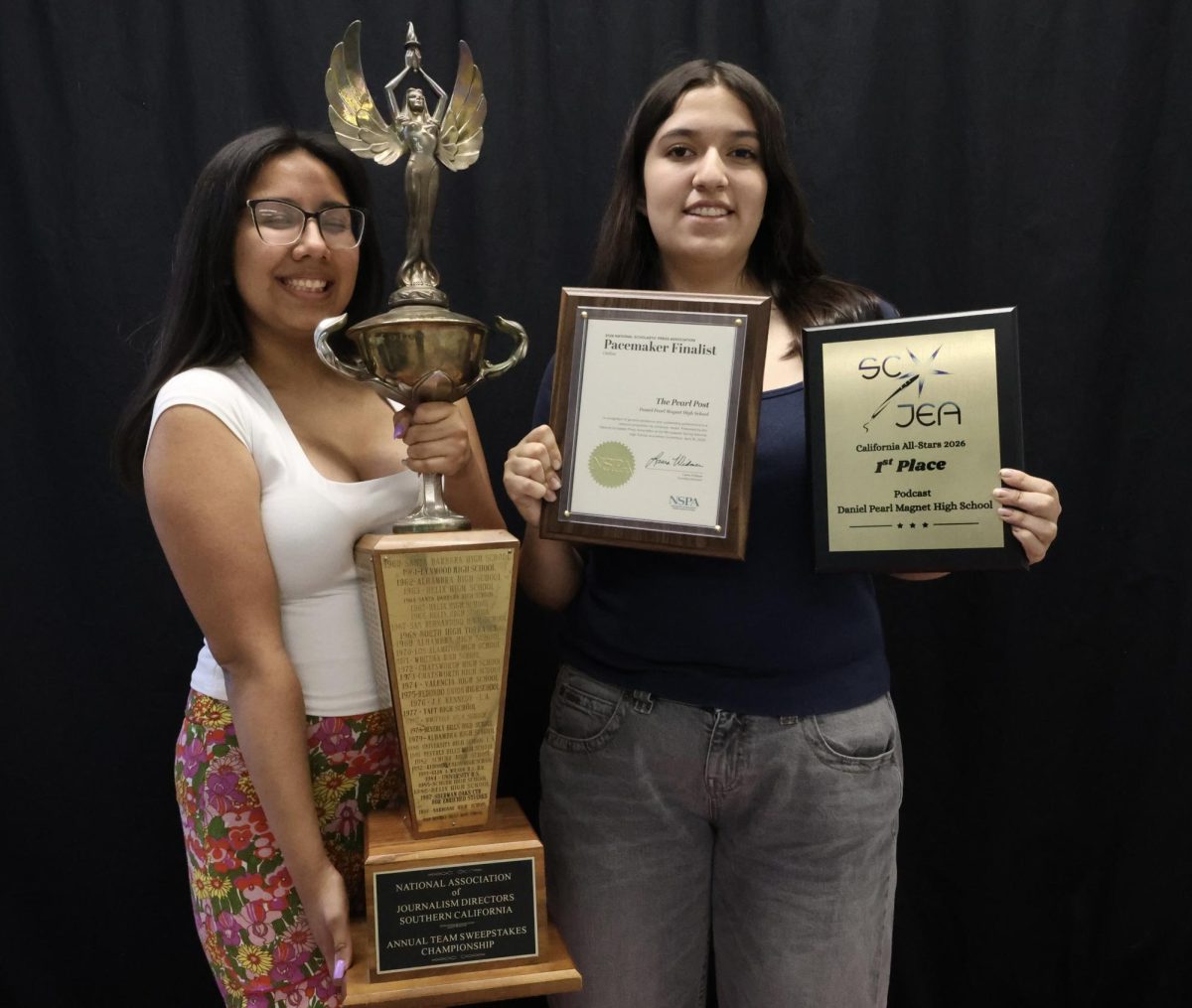
Despite both SPINWIP and GWC being virtual, they were both exciting and informative experiences. Whether it’s renovating The Pearl Post website with CSS and HTML, incorporating more data journalism into articles or adding more quizzes and games, I’ll use my new skills fully in my new role as online editor-in-chief of The Pearl Post.